Stones · 7 min read
Moissanite vs diamond: an honest comparison
Fire, hardness, cost, and ethics — what actually separates moissanite from diamond, and when each one is the right choice.
By Ray Kim ·
Where moissanite comes from
Henri Moissan found the first moissanite in 1893 in the Canyon Diablo meteorite crater in Arizona, and initially mistook it for diamond. Natural moissanite is vanishingly rare, so every stone on the market — including every stone we set — is created in a laboratory.
That origin story is not marketing. Silicon carbide genuinely arrived here from space, and it is the reason we pair it with jade: one stone from the sky, one from the ground.
Fire and brilliance
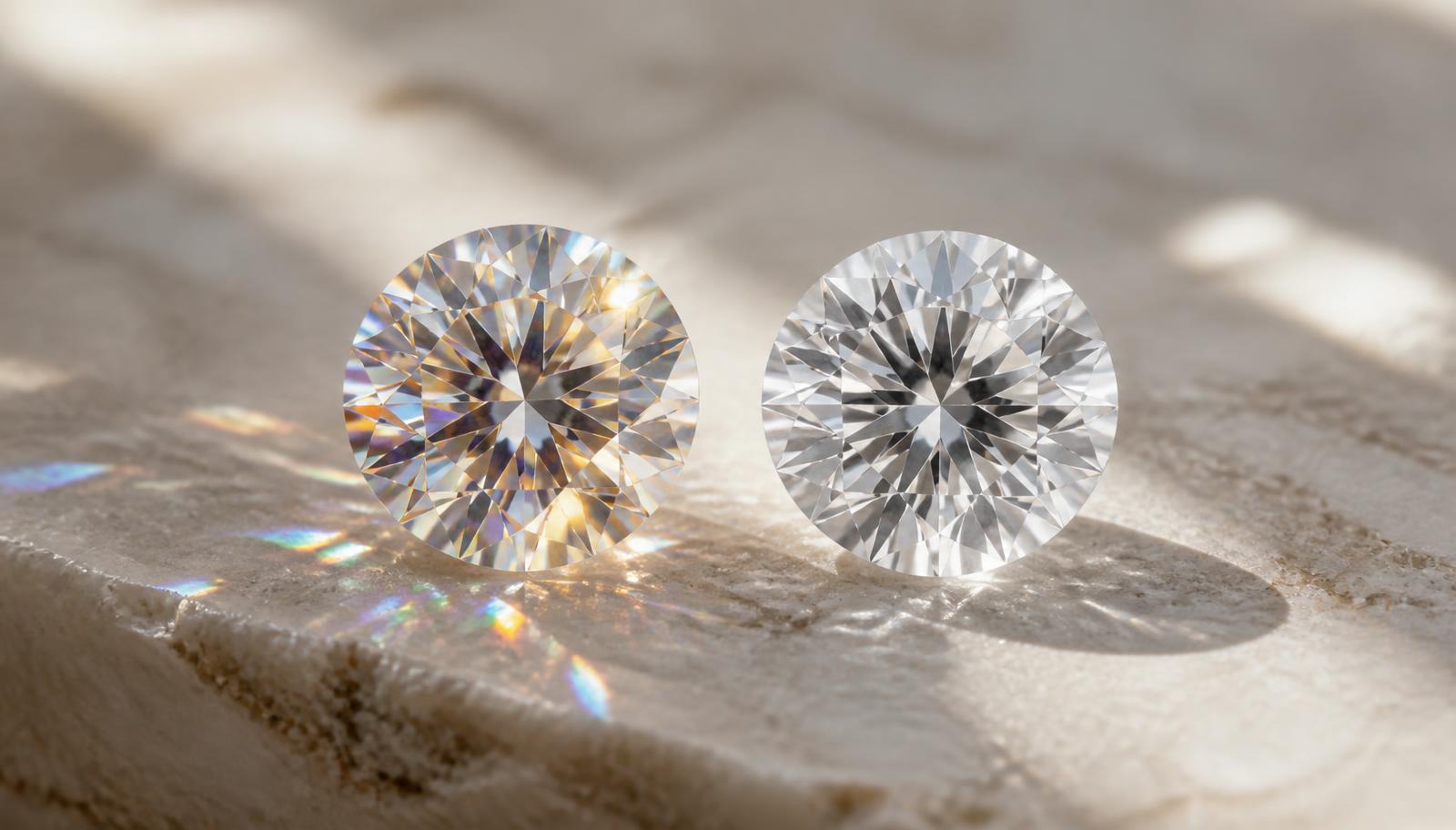
Moissanite has a dispersion of 0.104 against diamond's 0.044 — it splits white light into spectral colour more than twice as strongly. In practice, that means visible flashes of colour where a diamond returns mostly white light.
Whether that is better depends entirely on taste. Some people want the restraint of a diamond. Others want the fire. Neither is wrong; they are different stones doing different things.
Hardness and daily wear
Diamond is 10 on the Mohs scale; moissanite is 9.25. Both are far above the threshold that matters for jewelry. A moissanite worn every day for decades will not cloud, dull, or scratch in ordinary use.
Cost and ethics
Moissanite typically costs a small fraction of a comparable diamond, which changes what a piece can be — a larger stone, a better setting, or simply a piece you did not have to justify.
Because it is lab-created, moissanite carries no mining chain to audit. That is a straightforward answer to a question diamond buyers have to work much harder to answer.
When diamond is still the right call
If resale value, tradition, or a specific family expectation matters to you, diamond has an infrastructure moissanite does not. We would rather say that plainly than pretend otherwise.